All ranks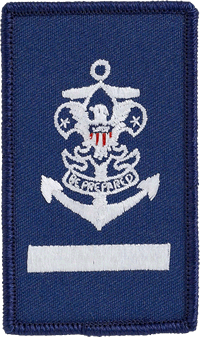
Apprentice
Sea Scouting
2022 requirements
Requirements
Striving for Apprentice rank, active Sea Scouts learn ideals, courtesies, procedures, and responsibilities, and how members of a ship are organized and uniformed. Basic swimming and beginning seamanship skills are required, as is knowledge of safety, emergency procedures, and Safe Swim Defense. Sixteen hours of service in ship projects, activities, or equipment maintenance fill out the requirements
1.
Ideals
(a)
Qualify as a member of your Sea Scout ship by taking part in the ship's admission ceremony.
(b)
Repeat from memory and discuss with an adult leader, an Able Scout or a Quartermaster Scout the Scout Oath and Law and the Sea Promise, and agree to carry out the provisions of your ship's code and bylaws.
(c)
Demonstrate acceptable courtesies used aboard a Sea Scout vessel.
(d)
Demonstrate the proper procedure for boarding a Sea Scout vessel and landship.
(e)
With other Sea Scouts, friends or family members, complete the Personal Safety Awareness Training for BSA's Older Youth Programs led by an adult leader or designee. The adult conducting the program should follow the program guidelines found in www.seascout.org/leader-resources in order to complete this requirement.
2.
Active Membership
(a)
Provide evidence that you are fulfilling your financial obligations to your ship, including helping with fund-raisers.
(b)
Obtain a Sea Scout uniform. Describe the Sea Scout uniforms. Tell how and when to wear the uniforms; and explain care of uniforms.
(c)
Meet your ship's bylaws requirement for active participation in your ship's meetings and activities for three months.
3.
Leadership
(a)
Describe your ship's organization, including the participant and adult leadership positions.
(b)
Demonstrate your ability to identify insignia of participant and adult leadership positions. Explain the chain of command in your ship.
4.
Swimming
(a)
Demonstrate your ability to swim by doing one of the following:Jump feet first into water over your head, swim 75 yards/meters in a strong manner using one or more of the following strokes: sidestroke, breaststroke, trudgen, or crawl; then swim 25 yards/meters using the elementary backstroke.The 100 yards/meters must be swum continuously and include at least one sharp turn. After completing the swim, rest by floating on your back, remaining as motionless as possible.
(b)
Discuss the BSA Safe Swim Defense plan and explain how it is used to protect Sea Scouts and other groups during swimming activities.
5.
Safety
(a)
Explain the uses, advantages, and disadvantages of the various types of Coast Guard-approved life jackets. Demonstrate the proper use and care of life jackets used by your ship. Discuss your stat's boating laws as they relate to life jacket wear.
(b)
Identify Distress Signals OR Paddlecraft basic hand, paddle, and whistle signals
Complete 1 of the following
(1)
Identify visual day and night marine distress signals, and know their location and the proper use for your ship's vessel(s)
(2)
Know and demonstrate basic hand, paddle, and whistle signals commonly used on paddlecraft trips.
(c)
Use the Distress Communications Form to demonstrate the procedure to send the following VHF emergency messages: Mayday, Pan Pan, and Security.
(d)
Know safety rules for vessels and equipment. Do ONE of the following:
Complete 1 of the following
(1)
Know the safety rules that apply to vessels and equipment used by your ship, and safety standards in the use of power tools, machinery, lifting heavy objects, and other safety devices used by your ship.
(2)
Obtain and discuss with your leader or designee, your state's paddlecraft safety rules for the craft most frequently used by your ship.
(e)
Obtain a current copy of the U.S. Coast Guard Auxiliary (USCG AUX) or America's Boating Club (ABC) Vessel Safety Check (VSC) Form online. With an approved Vessel Examiner or an experienced adult leader, perform a VSC on the vessel(s) in use by your Ship. Additionally, obtain, or create your own, USCG "IF FOUND" sticker(s). Complete the contact information and place it on the vessel(s) used by your Ship. If your Ship's vessel(s) already displays an "IF FOUND" sticker, verify the contact information is still correct. If not, correct it.
6.
Using both large and small lines, tie and explain the use of the following knots: overhand, square, figure eight, bowline, two half hitches, clove hitch, sheet bend,
cleat hitch, and trucker's hitch..
7.
Boat Handling
(a)
Name the principal parts of a typical sailboat, runabout, canoe, kayak, SUP, and raft
(b)
Describe the identifying characteristics of
1. A sloop, ketch, yawl, cutter, and schooner
2. An open motorboat and cabin motorboat
3. A touring canoe and whitewater canoe
4. A whitewater kayak and sea kayak
5. Oar frame raft and a paddle raft
1. A sloop, ketch, yawl, cutter, and schooner
2. An open motorboat and cabin motorboat
3. A touring canoe and whitewater canoe
4. A whitewater kayak and sea kayak
5. Oar frame raft and a paddle raft
(c)
Demonstrate the ability to use a heaving line OR the ability to throw a rescue throw bag.
Complete 1 of the following
(1)
Demonstrate the ability to use a heaving line.
(2)
While on land, demonstrate the ability to throw a rescue throw bag and hit a four foot-wide target 30 feet (10 meters) away. Then, without hesitation, retrieve the line, and immediately throw it as a coil, and hit a 4 foot-wide target 21 feet (seven meters) away.
Finally, retrieve the line and re-stuff the bag
8.
Service
(a)
Log at least 8 hours of work on ship equipment, projects, or activities other than ship meetings, parties, dances, or fun events.
(b)
Participate with your ship for at least 8 hours in community service projects.
9.
Attend a Skippers Conference
10.
Successfully complete your board of review for Apprentice rank.